



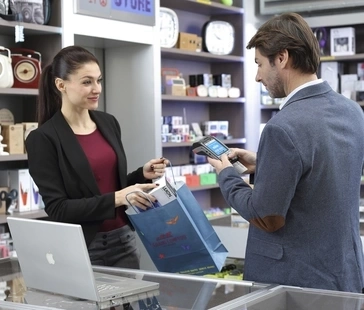
Research by Elavon shows where consumers prefer to shop, with the data showing that the high street is not dead, just different.
In an online survey of more than 1,000 adults Ireland, people were asked whether they shopped mostly online or in-store for groceries; household products; clothes, shoes and accessories; beauty products; furniture and home decorations; electrical goods and gadgets; and toys and games.
The results show that across Ireland, the majority of shopping is done in-store but that younger people are more likely to shop online than older.

The results broadly reflect the same survey carried out by Yonder on behalf of Elavon last year, suggesting these shopping habits are here to stay.
“While there was a move from the high street to online shopping in recent years, accelerated by the 2020 Covid pandemic, these results show the high street is not dead, just different,” says Scott Frisby, Head of Strategy at Elavon Europe.
“But it also shows that it is important for businesses to diversify, to offer different ways to pay, either in person at a shop, or online. Offering both these is known as omnicommerce.
“We can see that the supermarket shop, including independent food shops, remains the primary way people buy their groceries and household products, such as washing up liquid.
“Similarly, there is a strong showing for in-store for items which shoppers want to see such as furniture, beauty products and clothes.”
This idea reflects separate research by Elavon which revealed the primary reason people visit a shop is to see an item in person. This might be to try on clothes or sit on a settee.
Multicommerce
Another arresting piece of data highlights the importance of convenience to the consumer.
For all the categories barring groceries and household products, this option was important to about a fifth of all respondents. Younger people are even more likely to be swayed by convenience with about a quarter of under 24 year olds picking this option on the survey.
“Here we see consumers just going with the easiest place to buy. Here’s an opportunity for you, the retailer, to give yourself an edge over your competitors,” says Frisby.
“Make sure you offer different ways to pay, and make it a smooth, seamless process. This might be offering a self-checkout kiosk, self-scan and pay, paying at a traditional till, or a combination of those different methods.
“It might involve what we call de-coupling of the payment process from the delivery of service, where customers order their items and pay for it, freeing up your staff from the administrative process of payment.
“This is frequently already available in larger chains, but we see no reason why it won’t increasingly be taken up in smaller businesses, in both retail and hospitality.”
The data in greater depth
If you take a closer look at the survey results, the data shows that younger people are much more likely to shop online.
Groceries and household products remain broadly the same for all age groups. But for beauty products, those under 34 are almost as likely to shop online as they are at a store.
Meanwhile about half of all adults aged 18-34 buy electrical goods online while less than a third do so in store.
Conversely, almost two thirds (59%) of 55 – 64 year olds shop in-store and 72% of over 65s buy electrical goods in a shop.
For adults who buy toys and games, again, the under 34s buy online more frequently than in a shop, but it is not as strong a preference as for electrical goods.
Interestingly, men who buy electrical gadgets are much more likely to go online at 36% than women (27%).
“Our data shows that shoppers like choice,” says Frisby. “As a retailer, you need to understand your customer and how they want to buy.
“Choose a payments provider that help guide you through the many different options available so you’re not unnecessarily putting off custom.”
Elavon provides a one-stop shop for online and in-person payment solutions. Talk to us to find out more.
Source: Yonder conducted an online sample of 1,002 adults 18+ in Ireland between 27 February and 1 Marcy 2024. Data is weighted to be representative of the known population of Ireland. Yonder is a founding member of the British Polling Council and abides by its rules.
Question: Which of the following best describes the way you regularly shop for the following items over the last 12 months? Table rebased to exclude those who answered NA.
|
|
Groceries |
Clothes, shoes and accessories |
Household products (e.g. cleaning products, laundry products, bin liners, kitchen towels) |
Furniture & home decorations |
Beauty products |
Electrical goods and gadgets |
Toys and games |
|---|---|---|---|---|---|---|---|
|
Base |
995 |
989 |
994 |
925 |
803 |
970 |
646 |
|
I shopped mainly online for this |
7% |
33% |
8% |
13% |
24% |
32% |
36% |
|
I shopped mainly in store for this |
88% |
47% |
85% |
69% |
57% |
49% |
39% |
|
I shopped wherever is convenient for this |
5% |
20% |
7% |
17% |
19% |
19% |
25% |
Base
Groceries
995
Clothes, shoes and accessories
989
Household products (e.g. cleaning products, laundry products, bin liners, kitchen towels)
994
Furniture & home decorations
925
Beauty products
803
Electrical goods and gadgets
970
Toys and games
646
I shopped mainly online for this
Groceries
7%
Clothes, shoes and accessories
33%
Household products (e.g. cleaning products, laundry products, bin liners, kitchen towels)
8%
Furniture & home decorations
13%
Beauty products
24%
Electrical goods and gadgets
32%
Toys and games
36%
I shopped mainly in store for this
Groceries
88%
Clothes, shoes and accessories
47%
Household products (e.g. cleaning products, laundry products, bin liners, kitchen towels)
85%
Furniture & home decorations
69%
Beauty products
57%
Electrical goods and gadgets
49%
Toys and games
39%
I shopped wherever is convenient for this
Groceries
5%
Clothes, shoes and accessories
20%
Household products (e.g. cleaning products, laundry products, bin liners, kitchen towels)
7%
Furniture & home decorations
17%
Beauty products
19%
Electrical goods and gadgets
19%
Toys and games
25%
16 August 2024




Helping thousands of customers around the world grow their business through payments
Customer service and support
We’re here to help!
Customer service: 0818 20 21 20
Telephone: Monday to Friday, 8am to 5pm
Chat: Monday to Friday, 8am to 6pm
Elavon technical support: 0818 20 21 20
24 hours a day, 365 days a year
Opayo product support: 01 240 8731
24 hours a day, 365 days a year
Privacy policy
Data Privacy Notice
Cookie policy
Accessibility statement
Legal
Modern slavery act
Our Regulatory Status
Copyright© 2026 | U.S. Bank Europe DAC. Registered in Ireland – Number 418442. Registered Office: Block F1, Cherrywood Business Park, Dublin 18, D18 W2X7, Ireland.
U.S. Bank Europe DAC, trading as Elavon Merchant Services, is regulated by the Central Bank of Ireland.
We are regulated by the Central Bank of Ireland for our acquiring, transaction risk analysis, and dynamic currency conversion services. For all other products and services we provide, please note the following:
Warning: The provision of this service does not require licensing, registration, or authorisation by the Central Bank of Ireland, and as a result is not covered by Central Bank of Ireland rules designed to protect consumers or by a statutory compensation scheme.
Helping thousands of customers around the world grow their business through payments
Customer service and support
We’re here to help!
Customer service: 0818 20 21 20
Telephone: Monday to Friday, 8am to 5pm
Chat: Monday to Friday, 8am to 6pm
Elavon technical support: 0818 20 21 20
24 hours a day, 365 days a year
Opayo product support: 01 240 8731
24 hours a day, 365 days a year


Privacy policy
Data Privacy Notice
Cookie policy
Accessibility statement
Legal
Modern slavery act
Our Regulatory Status
Copyright© 2026 | U.S. Bank Europe DAC. Registered in Ireland – Number 418442. Registered Office: Block F1, Cherrywood Business Park, Dublin 18, D18 W2X7, Ireland.
U.S. Bank Europe DAC, trading as Elavon Merchant Services, is regulated by the Central Bank of Ireland.
We are regulated by the Central Bank of Ireland for our acquiring, transaction risk analysis, and dynamic currency conversion services. For all other products and services we provide, please note the following:
Warning: The provision of this service does not require licensing, registration, or authorisation by the Central Bank of Ireland, and as a result is not covered by Central Bank of Ireland rules designed to protect consumers or by a statutory compensation scheme.

Essential cookies enable core functionality such as page navigation and access to secure areas. The website cannot function properly without these cookies; they can only be disabled by changing your browser preferences. Please see our Cookie Policy for further information.
Performance cookies help us to improve our website by collecting and reporting information on its usage (for example, which of our pages are most frequently visited).
These cookies and similar technologies gather information about your browsing habits. They remember that you've visited a website and share this information with other organisations, such as advertisers and platforms on which we advertise. They do this in order to provide you with advertisements that are more relevant to you and your interests. These cookies and similar technologies gather information about your browsing habits. They remember that you've visited a website and share this information with other organisations, such as advertisers and platforms on which we advertise. They do this in order to provide you with ads that are more relevant to you and your interests.
Find out more about cookies on https://www.allaboutcookies.org